Plonky3
Plonky3 Explained: Architecture, Setup and Plonky2 Differences
How Plonky3 is structured, how to set it up, and what changes compared with Plonky2.
In Plonky3, your trace generator and your AIR are separate code, and only the AIR binds the prover. AI agents review both, ZK Vanguard catches the columns your constraints leave loose, and Picus backs the result with formal verification.
For AIRs and trace generators written in Rust. ZK Vanguard results in seconds to minutes, depending on complexity.
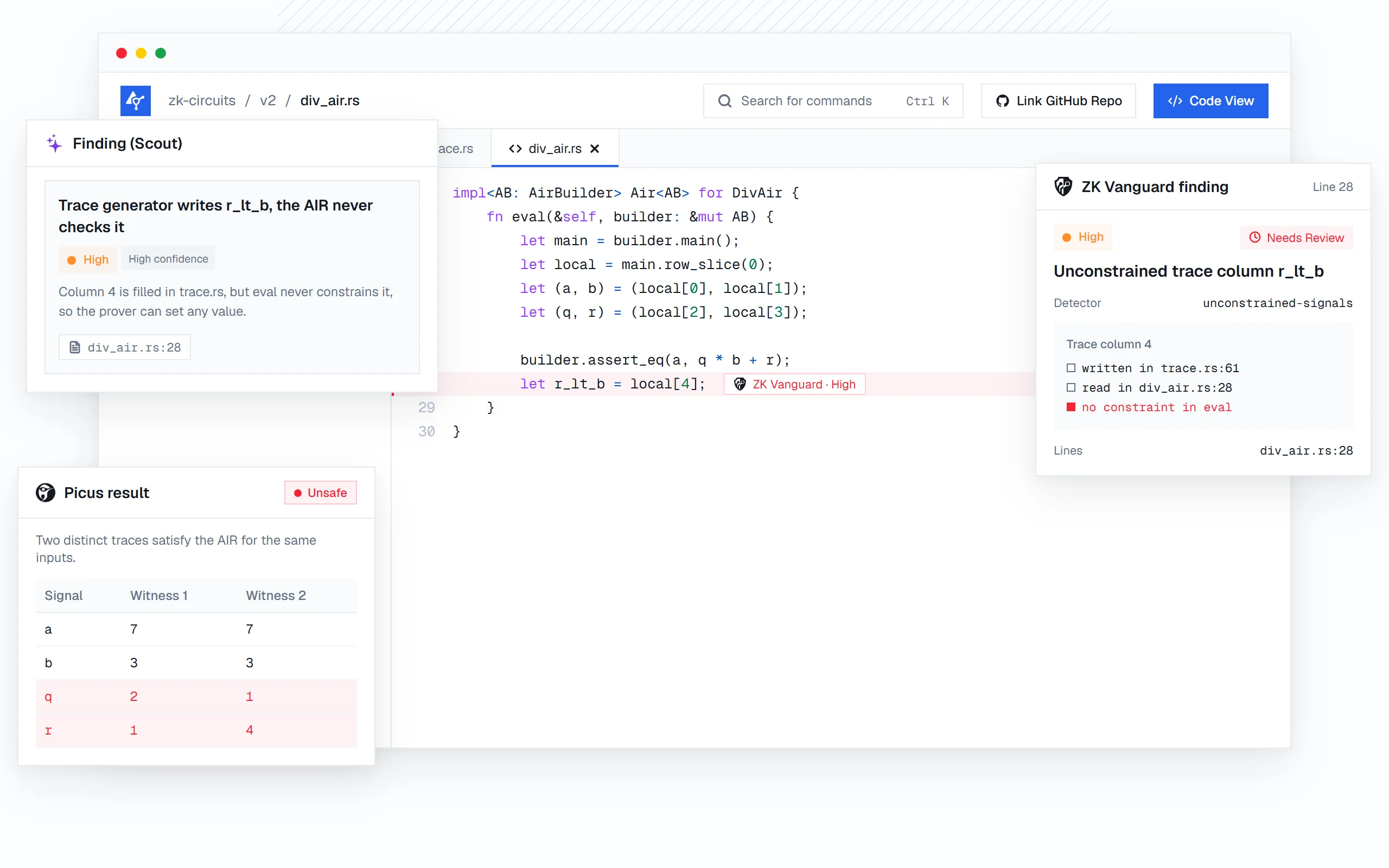
Scout reads your AIR definitions and the trace generation code that feeds them, builds a threat model for the circuit, and reports what it finds. It works even before your crate compiles.
What your AIR must guarantee: the public values it exposes, and what a valid proof should attest.
Boundary rows, transition gating and how each column gets filled, read the way a reviewer would.
Each suspect in your AIR goes to ZK Vanguard or Picus and comes back with tool output behind it.
For every AIR you change, the same pair runs: ZK Vanguard catches likely underconstrained signals; Picus proves their absence.
Detects underconstrained columns, witness leakage, non-deterministic dataflow and unused components in your constraints. Results in seconds to minutes.
// PLONKY3
Explore ZK Vanguard →Proves your AIR fixes every output for given inputs, or returns two distinct witnesses that satisfy every constraint.
// PLONKY3
Explore Picus →STARK-friendly fields are small and AIR constraints only see what you wire into them, so the classic bugs look different from R1CS.
| Vulnerability | What happens | Covered by |
|---|---|---|
| Column never constrained | A trace column your generator fills but no AIR constraint reads. | ZK Vanguard + Picus |
| Missing boundary constraint | An initial or final state never pinned on the first or last row, so a trace can start anywhere. | Picus |
| Ungated transition | A transition constraint applied on the last row, where it wraps around to the first. | Scout |
| Small-field overflow | BabyBear and KoalaBear are 31-bit fields: a u32 or a sum of limbs wraps without limb range checks. | ZK Vanguard + Picus |
| Non-boolean flags | A selector or flag column used as 0 or 1 but never constrained to be boolean. | ZK Vanguard + Picus |
| Trace and AIR disagree | Your generator computes one value while the AIR only enforces a weaker relation. | ZK Vanguard |
A fully constrained AIR can still encode the wrong logic: Scout reviews it against your threat model.
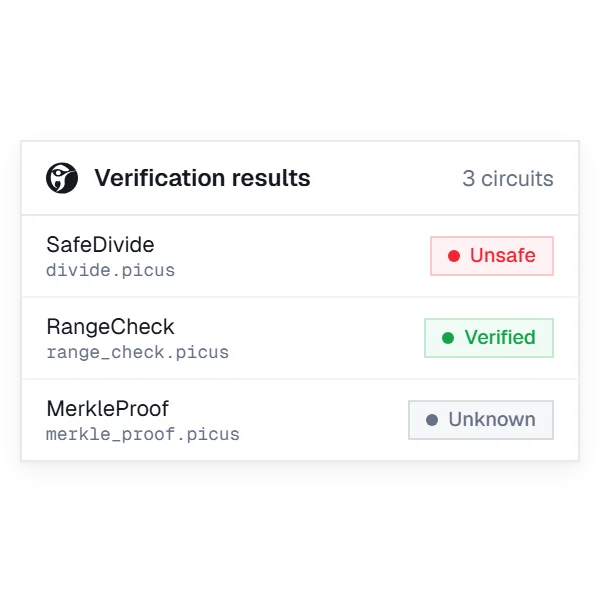
Scout flags a column your trace generator fills but no AIR constraint reads. Picus verifies the AIR and returns the evidence: two distinct witnesses that satisfy every constraint.
Your AIRs and trace generators stay in Rust, as they are. Determinism is a property of your constraints, not of FRI or your hash, so the result holds across the prover configuration you choose.
// 001
Your Plonky3 crate on GitHub.
// 002
Plonky3 AIRs are translated into LLZK, the intermediate representation ZK Vanguard analyzes.
// 003
GitHub Actions runs ZK Vanguard and Picus on each commit, before your AIR changes ship.
Building with a coding agent? Call the same tools from your session through AuditHub MCP.
AIRs get optimized after the audit, often to cut trace width or constraint degree, and each change can loosen a constraint. AuditHub rechecks every change in CI, and the audit still gives you a signed expert review.
Before audit
During audit
After audit
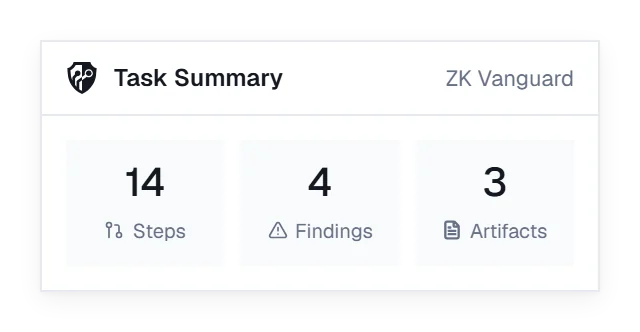
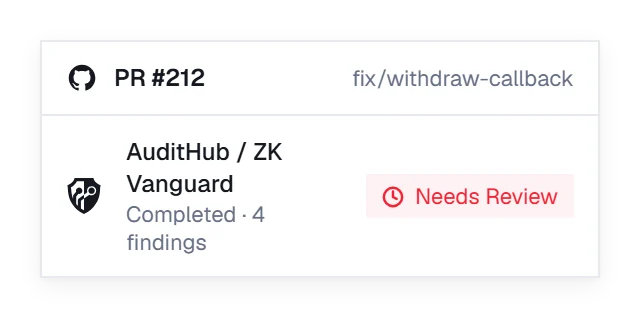
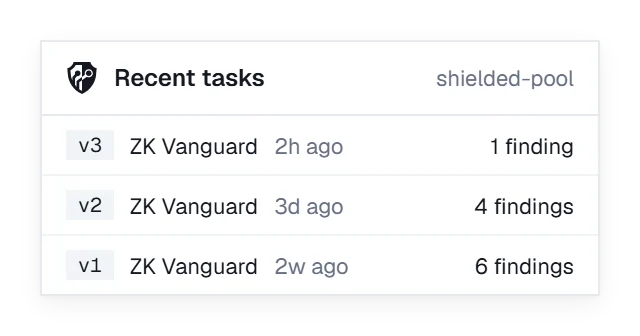
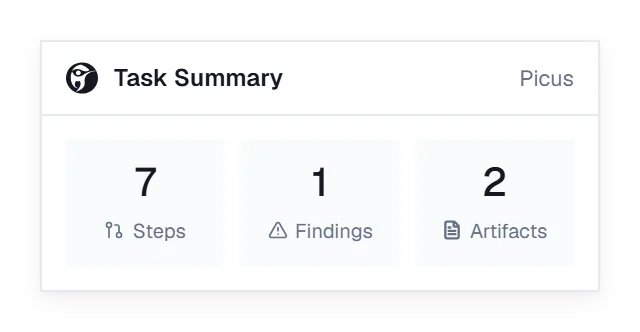
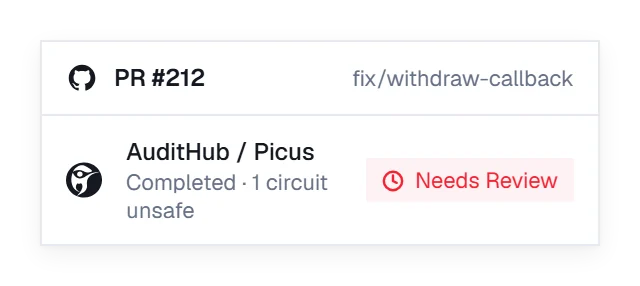
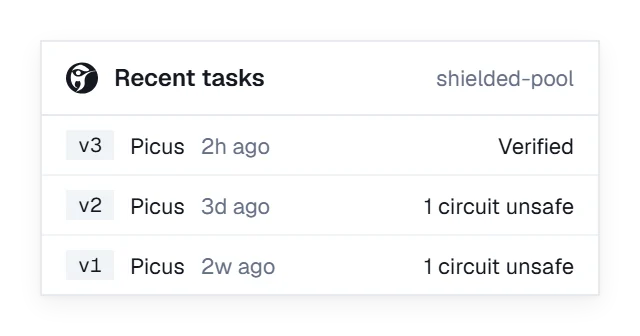
RISC Zero runs Picus in its CI on its zkVM circuits, where it surfaced 35 issues during development. Every new change is verified as the codebase evolves.
A column, boundary or transition the AIR does not fully pin down. A prover can then reach a different output from the same inputs and still produce a valid proof.
Yes. Picus returns verified when every output is uniquely determined by the inputs, unsafe with two distinct witnesses when it is not, or unknown when it can give neither.
ZK Vanguard runs first and catches likely underconstrained signals in seconds to minutes. Picus follows and proves their absence, or returns a concrete counterexample.
No. They check your AIRs continuously between audits, and the audit gives you a signed expert review.
Still have questions? Contact us
Plonky3
How Plonky3 is structured, how to set it up, and what changes compared with Plonky2.
ZK Security Audits
Why underconstrained signals and witness leaks break ZK circuits, and how to check for them.
Formal Verification
What a formal proof guarantees about a contract or circuit, and which questions it leaves open.
Run ZK Vanguard and Picus on your Plonky3 code today.