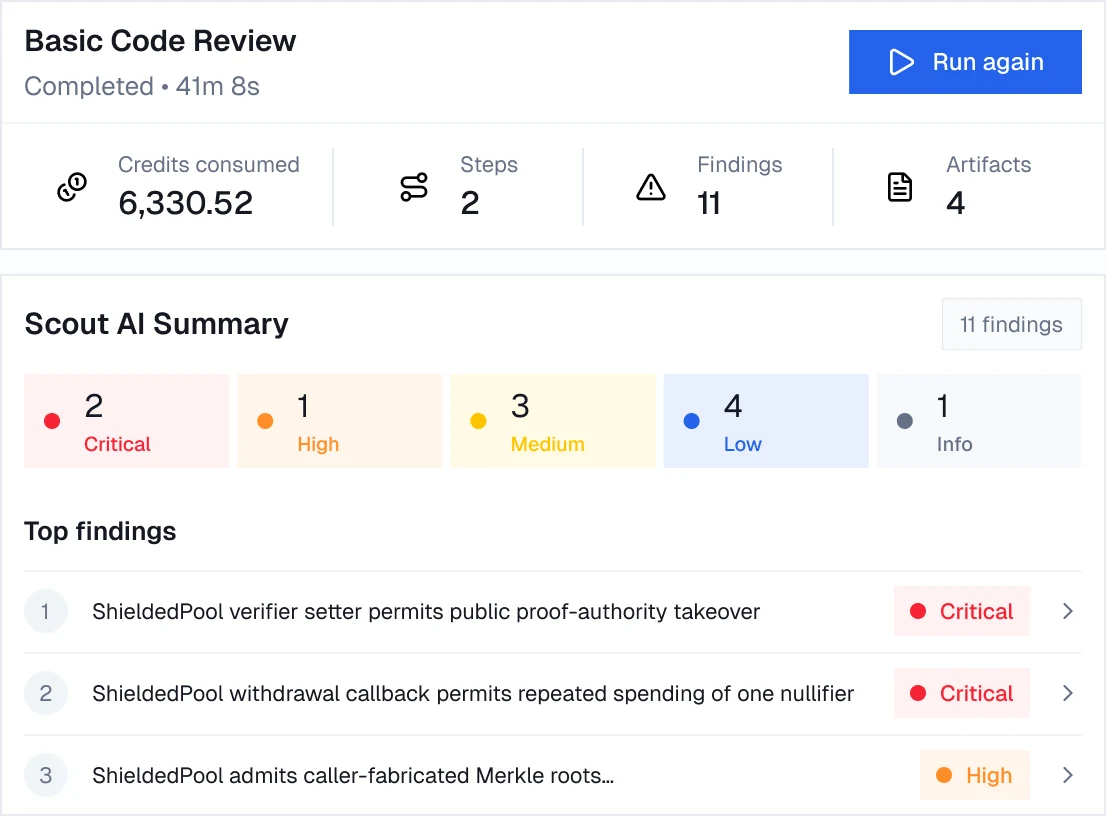
Basic code reviewer
Reviews your code the way a human reviewer would, even on code that doesn't compile yet.
// BEST FOR EARLY BRANCHESRun static analysis, specification-guided fuzzing, static analysis for ZK circuits, and formal verification for ZK circuits in one click. Scout plans the review, validates findings with the right tools, and remembers your protocol between runs, so no review starts from zero.
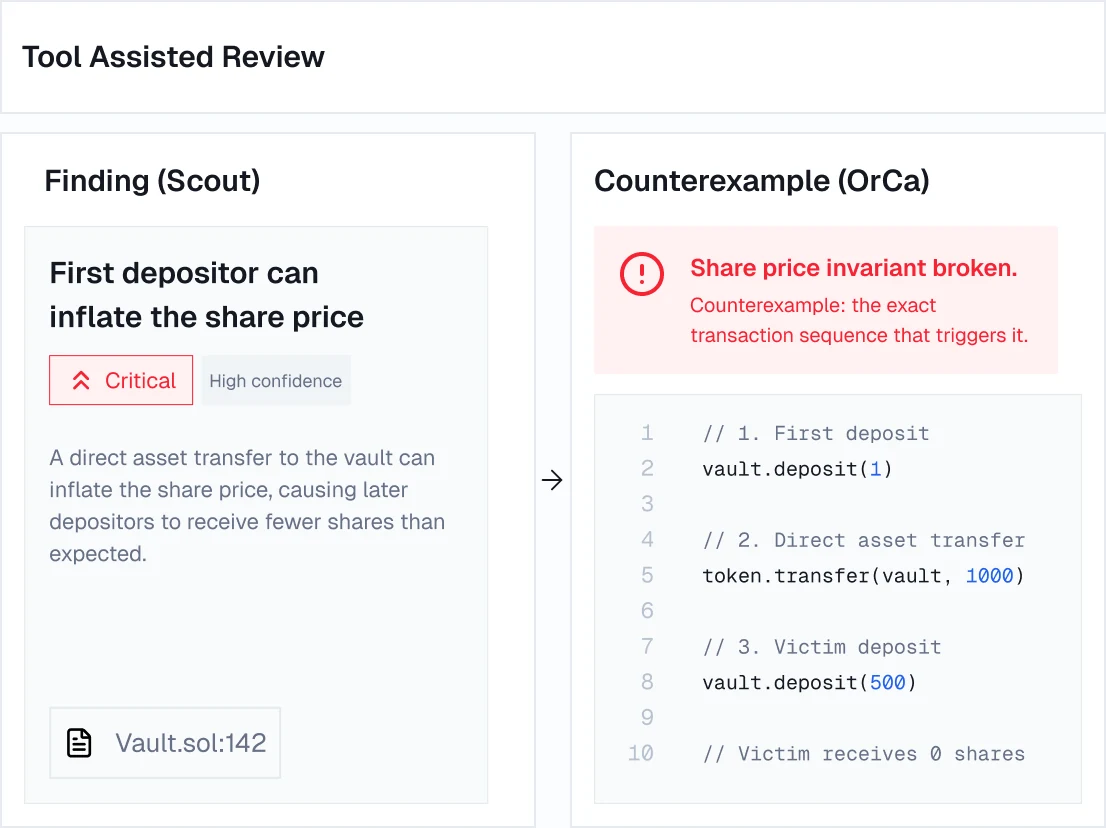
// Every tool-assisted finding comes with the tool output behind it.
// Works on code that doesn't compile yet.
Four steps in a loop. What you correct at the end is where Scout starts next time.
Maps the architecture, builds a threat model and proposes the invariants to enforce.
// BUILD THE MODELLooks for the bugs an attacker could use, within the credit budget you set.
// TRACE THE PATHRuns the right security tool on each one: Vanguard, OrCa, ZK Vanguard or Picus.
// VERIFY WITH TOOLSKeeps your corrections and the protocol model for the next run.
// CARRY CONTEXT FORWARDCorrections and findings are stored and used to improve the next run
Start with a first read on any branch, then get tool-backed findings before an audit or a release.
Reviews your code the way a human reviewer would, even on code that doesn't compile yet.
// BEST FOR EARLY BRANCHES
Plans and runs Vanguard, OrCa, ZK Vanguard and Picus against its threat model. Each finding comes with a location, severity, confidence score and the tool output, including counterexamples.
// BEST FOR AUDITS AND RELEASESTell Scout a violation is expected during asynchronous settlement, and it updates the invariant and the threat model, so the next run flags real bugs, not known behavior.
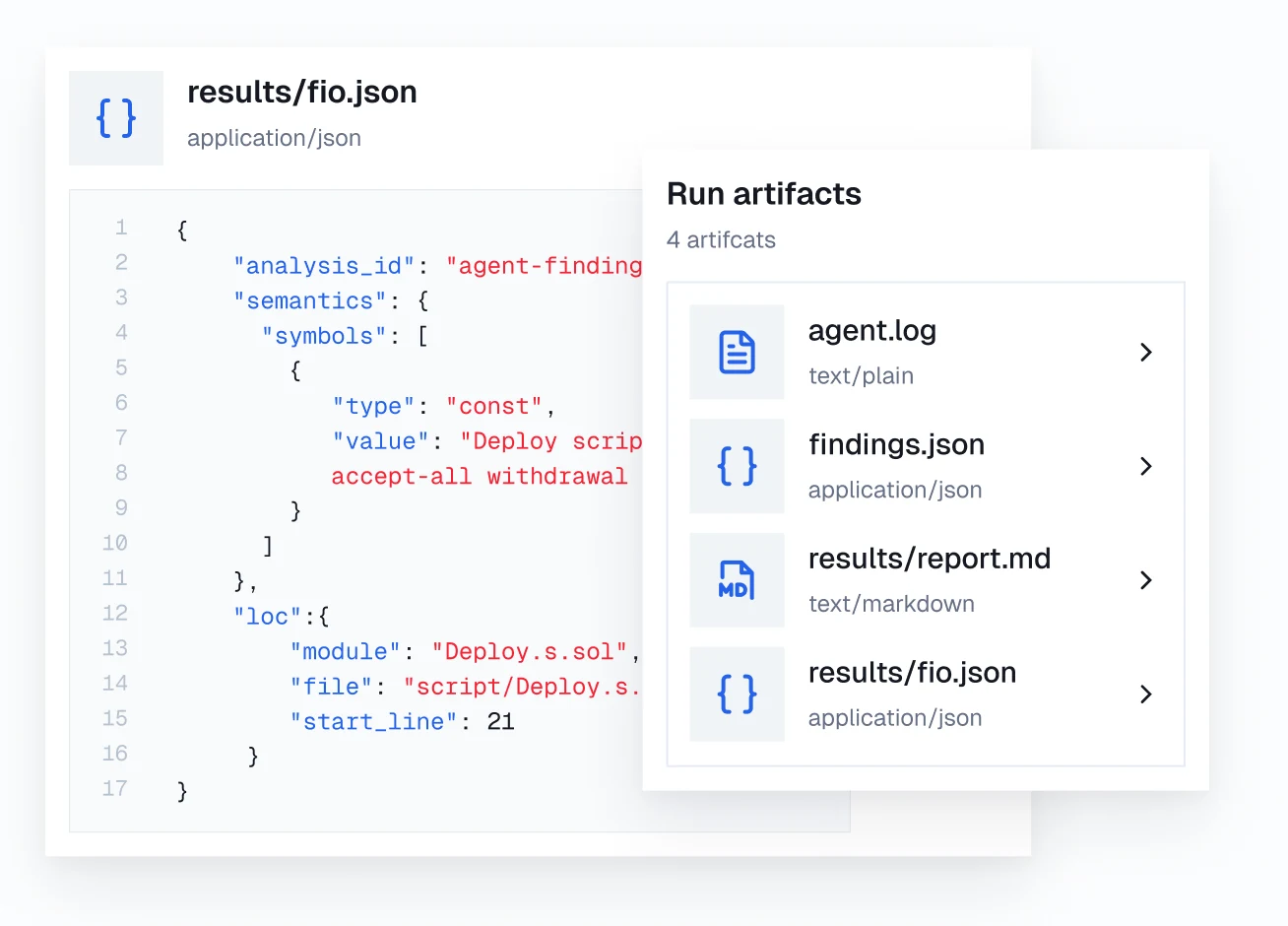
Scout works within the credit budget you set and logs every task with why it ran, so you see exactly what it did with your code.
Scout stops before going over and keeps every finding, even if the review didn't finish.
Every tool Scout runs is logged with its reasoning.
Findings and Scout's memory stay with the members of your AuditHub organization.
Delete a project when you no longer need it. This action can't be undone.
Your code and Scout's memory of it never train a model.
Read our Trust pageScout runs on frontier models like other assistants, and adds the memory, the tools and the budget a chat session lacks.
Builds a threat model around your protocolMaps its architecture and proposes key invariants.
Works from the context provided in the conversation
Remembers your protocol between runs.Retains its threat model and your corrections for future reviews.
Feedback primarily guides the current conversation
Tests findings with specialized security tools.Uses static analysis, fuzzing, and ZK security tools where applicable, attaching evidence to findings.
Primarily model reasoning and provided context
A credit budget you control.Set a budget for each review. Scout stops at the limit and keeps the findings already made.
Usage depends on the assistant and plan
Scout hands your auditors the threat model, the invariants and the findings with their tool output, so the audit starts from a higher baseline. The audit still gives you a signed expert review.
Everything you need to know about Scout, how it reviews your code, uses security tools, manages credits, and fits into your security workflow.
An AI agent that reviews your code for bugs, the way a reviewer would. Scout goes further: it learns your protocol, tests its findings with security tools built on formal methods, and remembers what it learned.
No. In Basic Code Reviewer mode, Scout reasons about incomplete code. Tool-backed checks run on the parts that build, and you still get findings on the rest.
Smart contracts and ZK circuits.
Scout works within the credit budget you set and stops before going over it, keeping every finding it has made. Credits per plan are listed on the Pricing page.
No. Scout handles the groundwork so your audit starts from a higher baseline. Judgment on what matters stays with your security team and your auditors.
Still have questions? Contact us
Point Scout at your smart contracts or ZK circuits today.