Security Tools
Smart Contract Security Tools: Static Analysis, Fuzzing, Proofs
What static analysis, fuzzing and formal proofs each catch, and how they fit together in one workflow.
For protocol engineers: static analysis, specification guided fuzzing and proof for ZK circuits, run by AI agents or on their own, all four included in every plan.
Trusted by RISC Zero, Succinct and Matter Labs.
Trusted by
Each tool applies one method to your code and returns evidence you can check.
Catches reentrancy, unchecked returns and unsafe patterns across contract boundaries.
// SOLIDITY
Discover Vanguard →Tests your contracts against the behavior you specify in [V], and returns exact inputs and traces when a property fails.
// SOLIDITY, RUST, SOROBAN
Discover OrCa →Catches likely underconstrained signals, witness leakage and non-deterministic dataflow.
// CIRCOM, HALO2, PLONKY3, ZIRGEN
Discover ZK Vanguard →Proves your circuits are deterministic, or returns a concrete counterexample.
// CIRCOM, HALO2, PLONKY3, ZIRGEN
Discover Picus →All four are included on every plan, Free included, at full strength. Compare plans
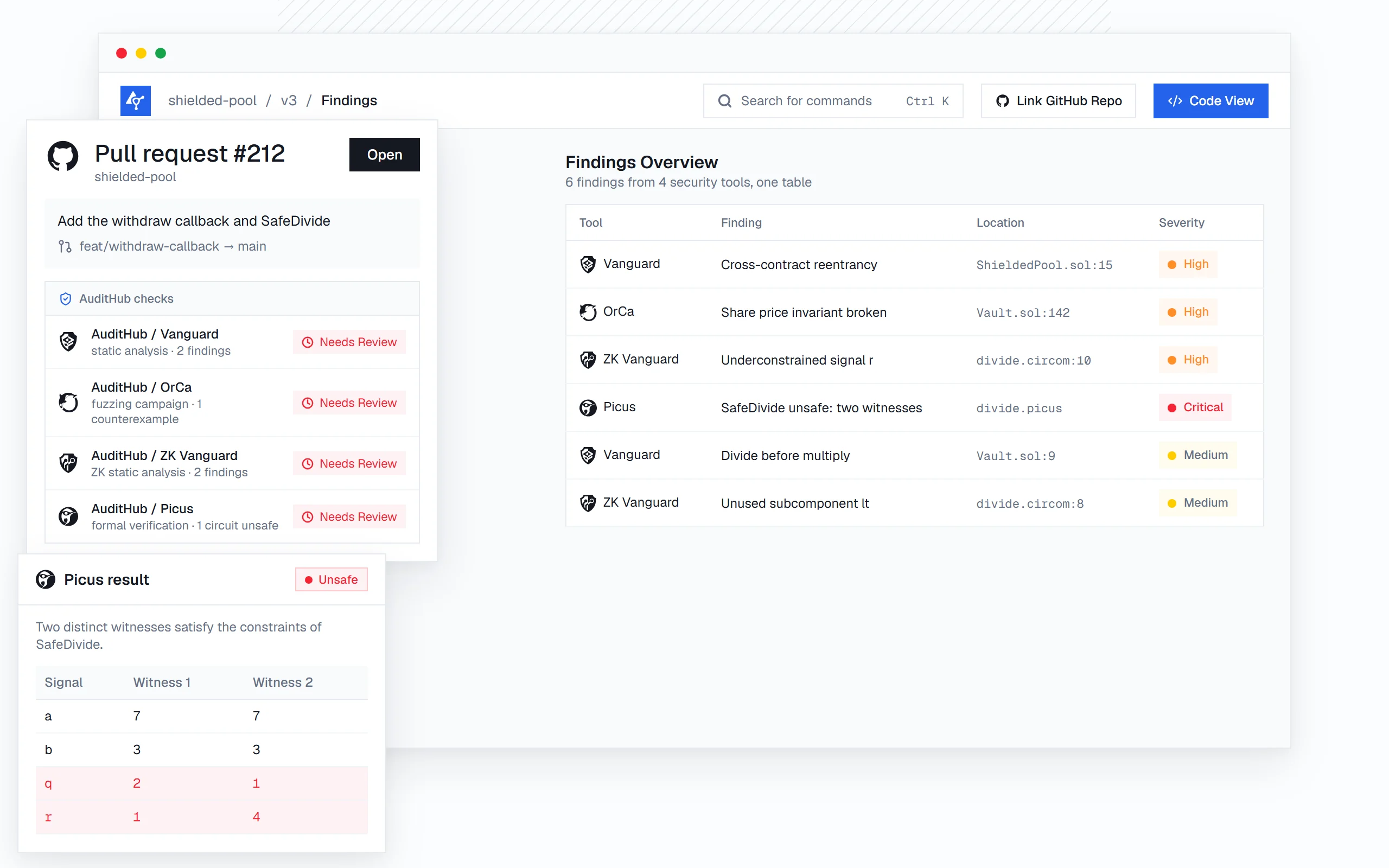
Two pairs, one shape: a fast static pass flags suspects, then a deeper tool returns a failing input or a proof. ZK Vanguard catches likely underconstrained signals; Picus proves their absence.
Smart contracts
Vanguard
Flags suspects
OrCa
Returns a failing input
ZK circuits
ZK Vanguard
Flags suspects
Picus
Returns a proof
Match the tool to your language and to what you need back.
| Tool | Method | Languages | Returns | Run it when |
|---|---|---|---|---|
| Vanguard | Static analysis | Solidity, on Foundry or Hardhat | Grouped findings with call graphs and value flow | On every commit, for breadth |
| OrCa | Specification guided fuzzing | Solidity, Rust, Soroban | Exact inputs and traces for every violation | You can state the behavior you expect |
| ZK Vanguard | Static analysis for ZK circuits | Circom, Halo2, Plonky3, Zirgen | Findings in seconds to minutes | On every commit, before proof |
| Picus | Formal verification | Circom, Halo2, Plonky3, Zirgen | A proof of determinism, or a counterexample | You need certainty |
Let Scout pick the right tool for each finding, call Vanguard and OrCa from your coding agent through AuditHub MCP, or run them yourself in GitHub Actions on every commit.
Picks and runs the tool for each finding.
The tools inside your coding agent.
The tools on every commit, during development.
On RISC Zero’s zkVM, Picus surfaced 35 issues during development, running in CI as the code evolved. All four tools were calibrated on 150+ security audits by Veridise auditors.
Software that checks contract and circuit code for vulnerabilities, before and between audits. AuditHub’s four tools cover static analysis, specification guided fuzzing and formal verification.
Static analysis examines code without running it. Fuzzing runs it against many generated inputs. Formal verification proves a property holds for every possible input.
For Solidity, start with Vanguard, then add OrCa once you can describe the behavior you expect. For ZK circuits, run ZK Vanguard first, then Picus for proof.
No. Run them on their own in GitHub Actions, through Scout, or, for Vanguard and OrCa, from your coding agent with AuditHub MCP.
Yes. Every plan, Free included, runs the same four tools at full strength.
Still have questions? Contact us
Security Tools
What static analysis, fuzzing and formal proofs each catch, and how they fit together in one workflow.
Fuzzing
How fuzzers and invariant tests work on smart contracts, and how to write properties that find real bugs.
Formal Verification
What a formal proof guarantees about a contract or circuit, and which questions it leaves open.
Connect a repository and see what the tools catch and prove.