ZK circuit formal verification that proves determinism

Picus proves your circuits are free of underconstrained bugs, the source of over 96% of bugs at that layer, or returns a concrete counterexample.

For Circom, Halo2, Zirgen and Plonky3.

Helped RISC Zero catch 35 issues in its zkVM during development.
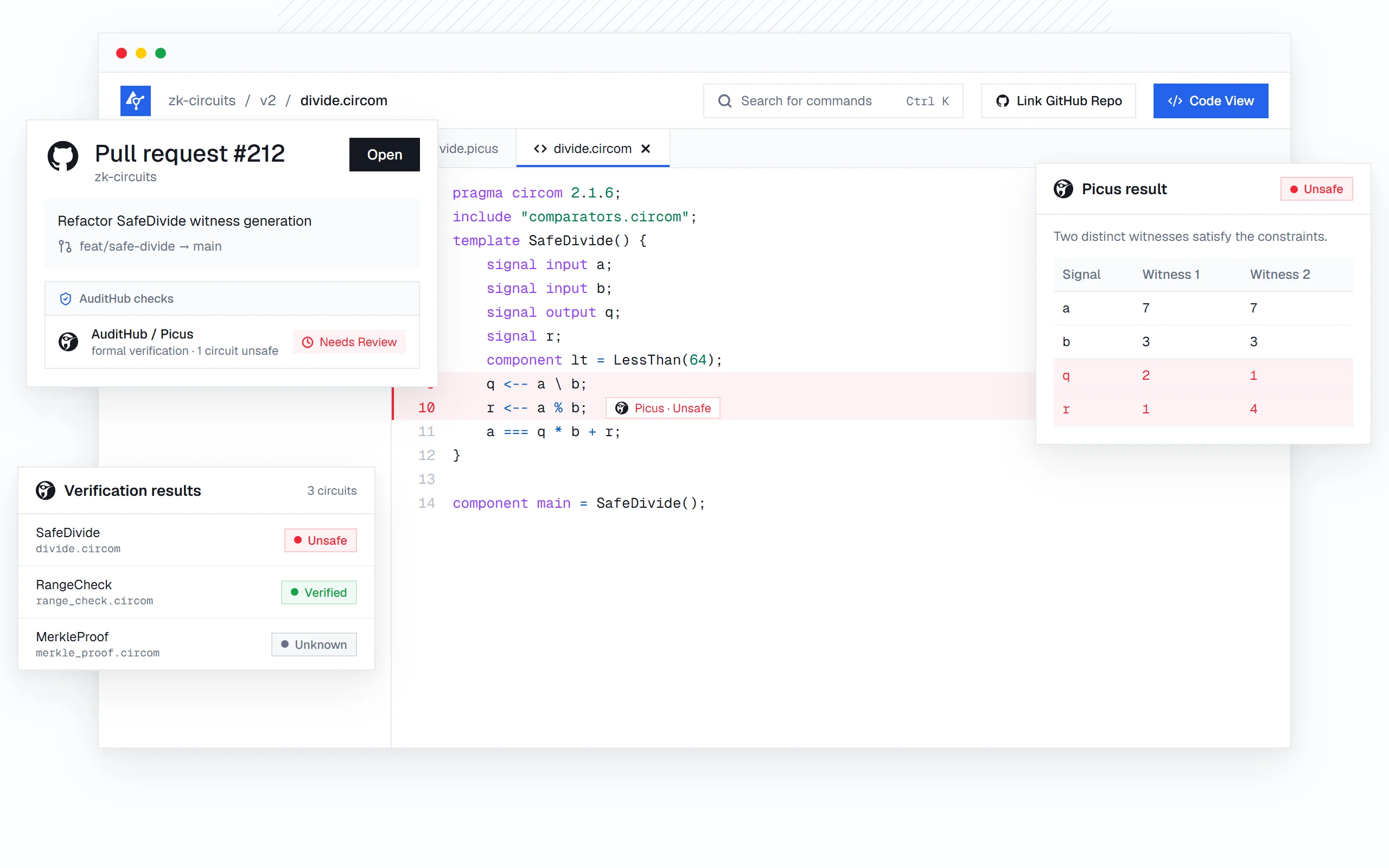
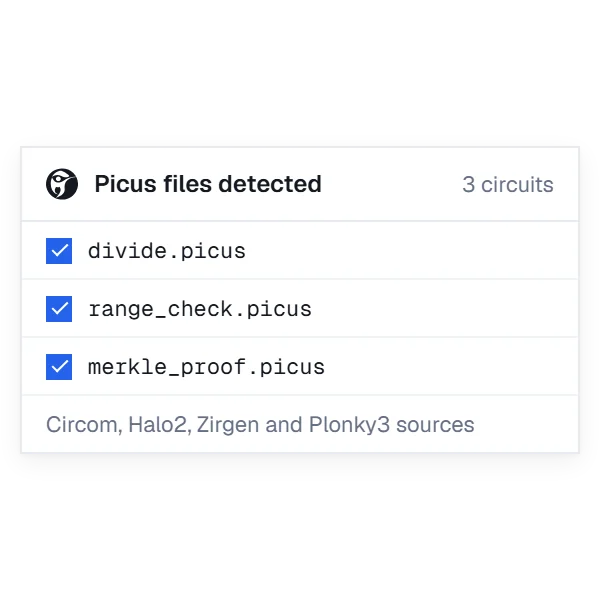
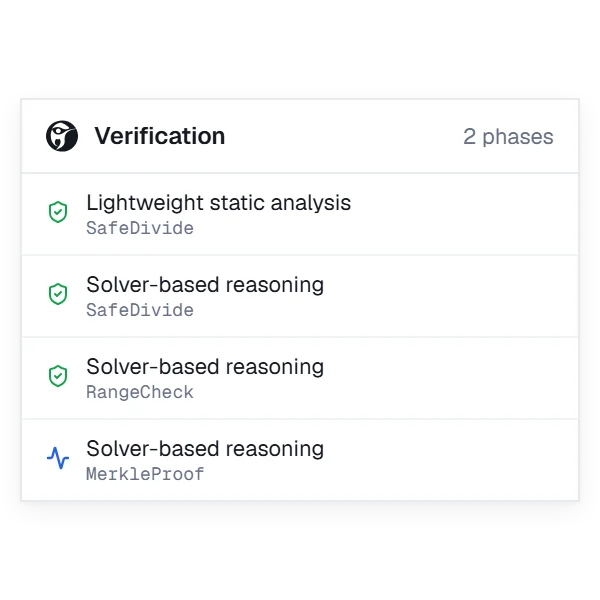
divide.circom open in AuditHub with lines 9 and 10 flagged by Picus: the Unsafe result with two distinct witnesses for the same inputs, verification results across three circuits, and the Picus check on the pull request.

What Picus proves about your ZK circuits

Picus targets one vulnerability class, the one behind over 96% of real-world ZK circuit layer bugs, and settles it with a proof.

// 001

Underconstrained circuits

Constraints too weak or incomplete to fix a single output for each input.

// 002

Exploitable proofs

Gaps an attacker could use to produce a valid proof for a false statement.

// 003

Nondeterministic outputs

Two distinct witnesses that satisfy the same constraints, returned as a concrete counterexample.

A verified result holds for every possible input, not just the ones you tested.

How ZK circuit formal verification works in Picus

Picus combines lightweight static analysis with solver-based reasoning. It proves that your constraints fix exactly one output for each input, across every possible input.

// 001

Connect your repository

Circom, Halo2, Zirgen or Plonky3 circuits.

// 002

Run the verification

Picus reasons over the constraints of each circuit, not over sampled inputs.

// 003

Review the result

A proof of determinism, or a counterexample you can reproduce.
From AI finding to a formal proof

Scout flags a signal it suspects is underconstrained. Picus verifies it and returns the evidence: a proof that the circuit is deterministic, or two witnesses that break it.

Scout AI - Findings

HighNeeds Review

Line 10

Signal r may be underconstrained

divide.circom:10
agent-findingcircuits/divide.circom

Picus - Evidence

Unsafe

Circuit is nondeterministic

Two distinct witnesses satisfy the constraints.

Witness 1, q2
Witness 2, q1

// COUNTEREXAMPLE FOUND

View both witnesses

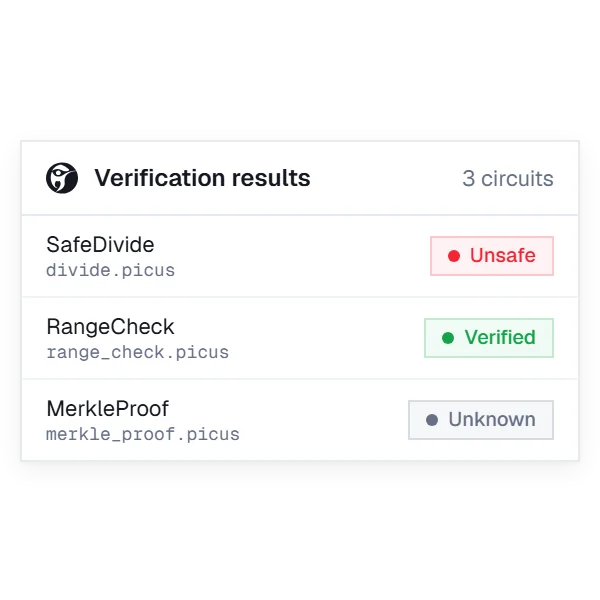
Every ZK circuit verification ends in one of three results

Picus does not guess. When it can neither prove determinism nor build a counterexample, it tells you so.

Verified

Your circuit is deterministic for every possible input.

Unsafe

Your circuit is provably nondeterministic.

Picus returns two distinct witnesses that satisfy the constraints.

Unknown

No proof and no counterexample, so no guarantee either way.

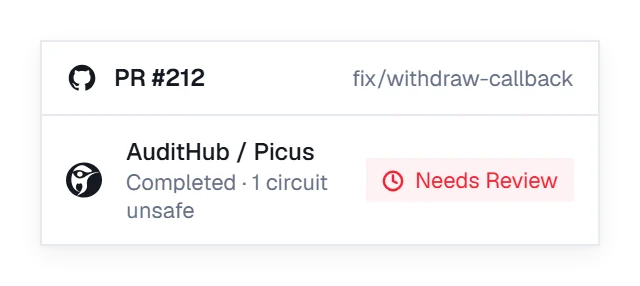
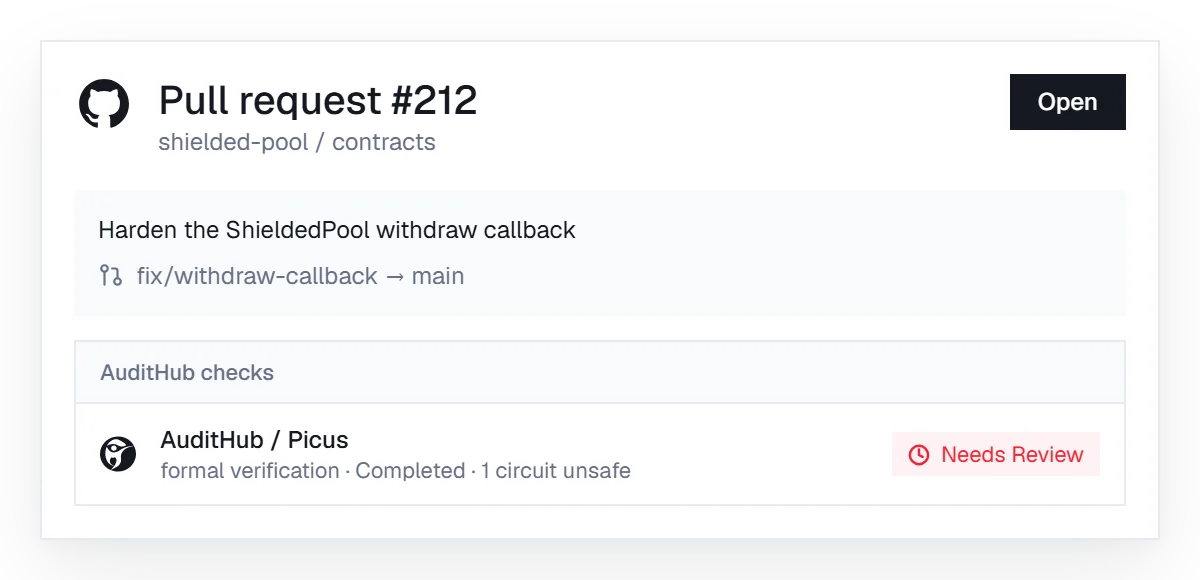
Pull request with the AuditHub Picus check: completed, needs review.

Formal verification in GitHub Actions, on every commit

Picus runs in your CI and re-verifies your circuits as your codebase evolves. A new underconstrained bug surfaces in the commit that introduced it, not weeks later.

ZK Vanguard runs first, Picus proves

ZK Vanguard catches likely underconstrained signals; Picus proves their absence. Run ZK Vanguard for a fast first pass, then Picus for a guarantee that holds for every input.

Static analysis for ZK circuits

Catches likely underconstrained signals in a fast first pass.

Formal verification for ZK circuits

Proves the absence of underconstrained signals, for every input.

Formal verification alongside your ZK security audit

Picus re-verifies your circuits on every change, so your auditors start from circuits already proven deterministic, or with the counterexamples in hand. The audit still gives you a signed expert review.

Before audit

During audit

After audit
Picus // EVERY CHANGE
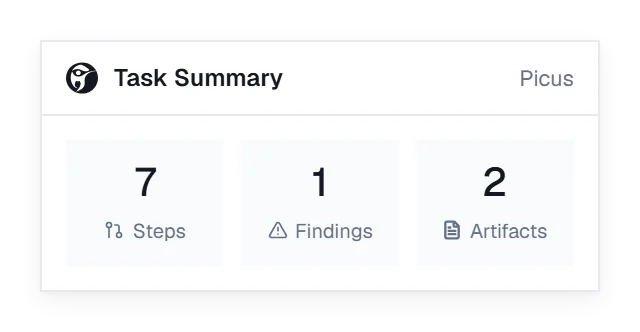
Picus task summary on the demo project: steps, findings and artifacts.
AuditHub Picus check on a pull request: completed, needs review.
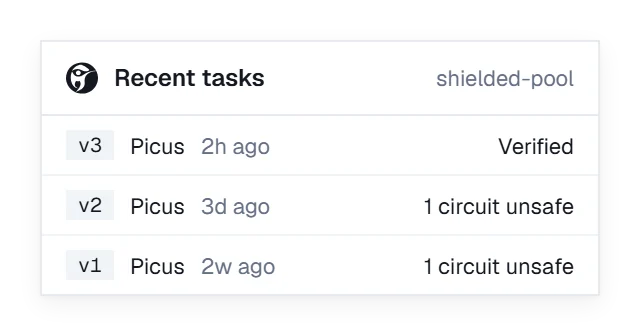
Picus recent tasks across versions v1 to v3 of the demo project.

RISC Zero: 35 issues fixed in its zkVM during development

RISC Zero runs Picus in its CI/CD pipeline to verify the determinism of its RISC-V zkVM. 35 issues surfaced and were mitigated during development, and every new change is verified as the codebase evolves.

ZK circuit formal verification FAQ

What is ZK circuit formal verification?

It uses mathematical reasoning to prove a property of your circuit for every possible input, not just the ones you tested. Picus proves determinism: each input fixes exactly one valid output.

What is an underconstrained circuit?

A circuit whose constraints are too weak to fix a single output for each input. An attacker can then produce a valid proof for a value you never intended.

Which ZK languages does Picus support?

Circom, Halo2, Zirgen and Plonky3.

What happens when Picus cannot reach a proof?

It returns unknown: no proof and no counterexample, so you know exactly where you stand.

How do Picus and ZK Vanguard work together?

ZK Vanguard catches likely underconstrained signals; Picus proves their absence. ZK Vanguard runs first for speed, Picus follows for the guarantee.

Still have questions? Contact us

Learn more about ZK circuit verification

Prove your circuits are deterministic before launch

Run Picus on your ZK circuits today.